


Questions about recovering at home?
Ask us anything, including what happens after you fly home. You'll meet your surgeon by video before you pay anything.
Start with a free consultationLanding at home after surgery in Thailand is a milestone. It also raises new questions. Who checks your wound now? What do you tell your GP? Who do you call if something doesn't feel right?
This guide covers the weeks after you fly home, and how your care continues from a distance.
Beauty Butler is a Bangkok-based medical tourism agency that coordinates cosmetic surgery for patients from Australia, New Zealand, the US, Canada and the UK.
Key Takeaways
- Most hands-on aftercare happens in Bangkok, at your follow-ups around day 7 and day 14.
- Bring your records, medicine list, fit-to-fly letter and written advice home in your hand luggage.
- Tell your GP you had surgery, and share your records. Your surgeon stays your first contact for anything about the operation.
- Learn the warning signs before you leave. In an emergency, call your local emergency number first.
- With Beauty Butler, you can email our aftercare team once you're home. We answer within 24 hours, and arrange a video call with your surgeon if needed.
What should you bring home after surgery in Thailand?
Bring a paper trail of your surgery: your records and operation details, your medicine list, your fit-to-fly letter and the written advice from your follow-ups. Keep them in your hand luggage. If a doctor at home ever needs to help you, these papers tell them exactly what was done and when.
Clothes are the easy part of packing. The papers matter more. The American Society of Plastic Surgeons advises surgeons to be ready to share a patient's records with any local doctor helping with follow-up care (ASPS, 2024). Having your own copy makes that easy.
Your checklist before you fly home
- Medical records and operation details. Ask before your last follow-up. With Beauty Butler, your records are available on request.
- Implant details, if you had breast implants. Ask your surgeon for the brand, size and type.
- A list of your medicines, with doses and how long to take each one.
- Your fit-to-fly letter. Your surgeon gives this at your follow-up, once you're cleared.
- The written summary of your follow-ups. It lists your surgeon's advice in plain words.
- Your aftercare guides, with instructions for showering, garments and activity.
- Your compression garment, plus any spare you were given.
- Our aftercare email address, saved in your phone before you leave.
For the flight itself, see our guide to flying after cosmetic surgery.
What happens with your stitches once you're home?
In most cases, stitches that need removing are taken out at your follow-ups in Bangkok, before you fly. Many others dissolve on their own over the following weeks. So most patients don't need anything done at home. If something does, your surgeon tells you before you leave.
A common question in patient groups is whether people had their stitches removed by their GP back home. Usually it isn't needed. That's one reason your stay matters: your surgeon wants to check your wounds in person, and handle anything that needs removing, before clearing you to fly. Our guide on how long to stay in Thailand explains the timing by procedure.
The ASPS asks surgeons to plan, before surgery, who will handle routine care like stitch removal and dressing changes if the patient can't return (ASPS, 2024). So at your last follow-up, ask whether any stitches are left, and whether they dissolve.
If a stitch does need removing at home, a practice nurse at your GP clinic can often do it. Take your written instructions with you.
Should you tell your GP about your surgery?
Yes. Tell your GP soon after you're home, and give them a copy of your records. Your GP knows your general health and your medicines. If you ever need care at home, they need to know what was done, when, and by whom.
Your GP didn't perform the operation, though. Questions about your result, scar or healing are best answered by your surgeon, who knows exactly what was done.
Your GP and your local health system look after you like any other patient, and emergencies are always treated. The one thing that may not be covered at home is cosmetic follow-up work, such as a revision. Rules differ between countries, so a quick check before you travel is worth it.
How do you look after your wound and scar at home?
Keep following the aftercare guides you were given in Bangkok: wound care, showering, garment wear and activity. Most wounds keep healing quietly for several weeks. Your job is to protect them, watch for changes, and be patient while swelling settles.
Your wound
- Keep your incisions clean and dry, as your guides explain.
- Don't soak in a bath, pool or the sea until your surgeon says it's safe.
- Don't pick at scabs or tape. Let them come off on their own.
- Take a photo of your incisions every few days in the same light. It makes small changes easy to spot and easy to share with your surgeon.
Your scar
Scars change for many months. Once the wound has fully closed, your surgeon may suggest silicone gel or sheets and gentle massage. Protect scars from the sun. Our guide to scar care after surgery covers the details.
Your garment
Keep wearing your compression garment as long as your surgeon advised. It helps control swelling. For a tummy tuck, the NHS says this is often about six weeks (NHS). Your surgeon may adjust the time for your procedure.
For the bigger picture of the weeks after surgery, read our complete guide to recovery in Thailand.
What warning signs should you watch for at home?
Most recoveries at home are smooth. Some swelling, bruising and tightness are normal for weeks. Spreading redness, heat, pus, a bad smell, a wound that opens, or a fever are signs to get checked. A wound infection can start any time from two or three days after surgery until the wound has healed, and rarely months later (Guy's and St Thomas' NHS Foundation Trust).
Get emergency help first
Recent surgery and long flights both raise the risk of blood clots. The NHS lists throbbing pain or swelling in one leg, usually the calf or thigh, as signs of a clot. If you also feel short of breath or have chest pain, it is an emergency (NHS).
In an emergency, call your local emergency number straight away: 000 in Australia, 111 in New Zealand, 911 in the US and Canada, or 999 in the UK. Then let us know, once you're safe.
How does Beauty Butler stay in touch after you fly home?
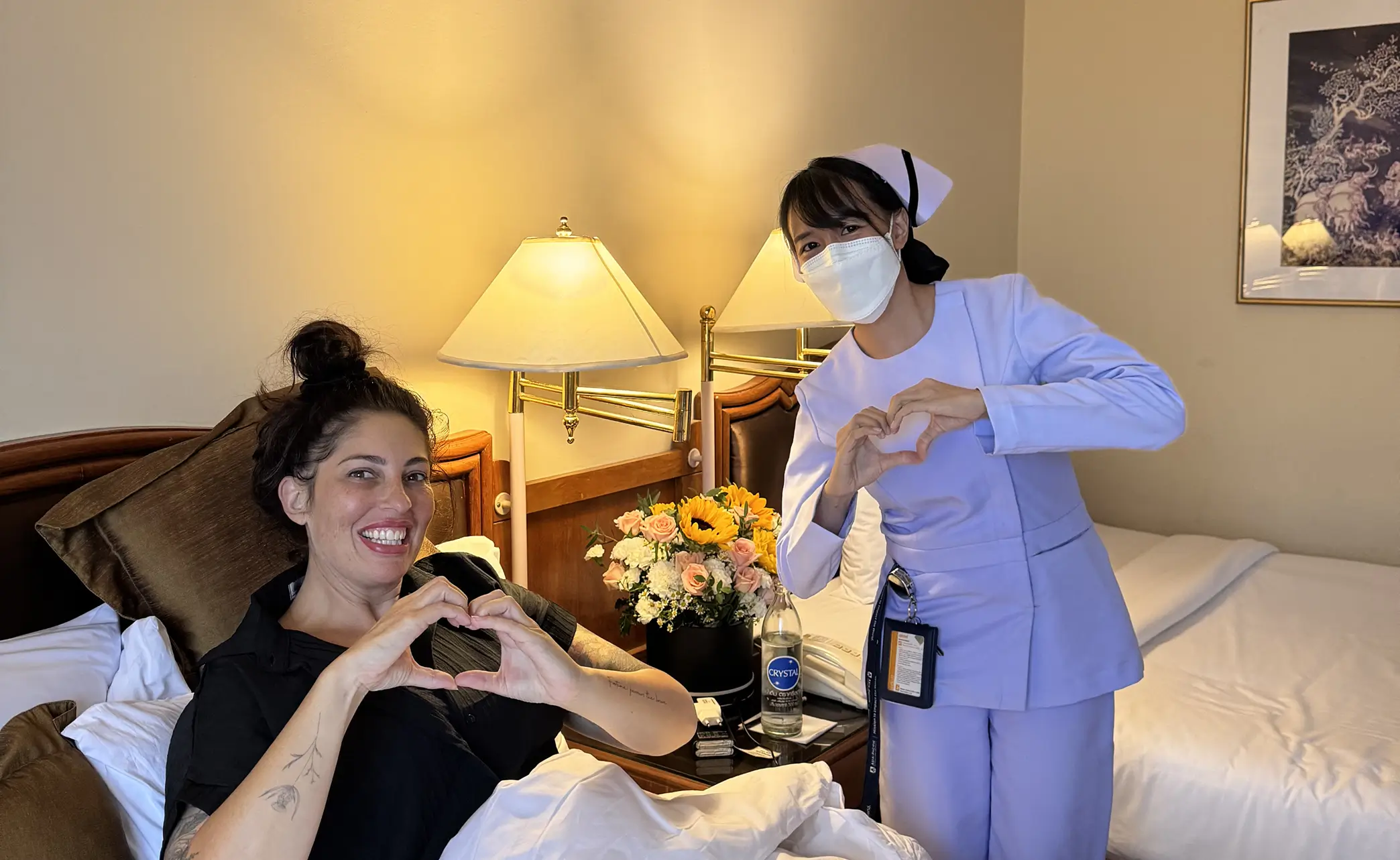
Once you're home, you email our aftercare team whenever you need us. We answer within 24 hours, every day, including weekends and holidays. If your surgeon needs to see you, we arrange a video call with them. You don't have to work out on your own whether something is normal.
Here's how your care runs from Bangkok to home:
- In Bangkok: our own nurses visit you at your hotel and come with you to your hospital follow-ups. Our recovery nurse guide explains what they do.
- At your follow-ups: your first is at about day 7, where you also receive your fit-to-fly letter once cleared. Your second is at about day 14, or earlier if you fly before then. After each one, we send you a written summary of your surgeon's advice.
- After you're home: there is no routine appointment to attend. Instead, you email questions and photos whenever you need to. Your records are available on request.
- If your surgeon confirms a surgical issue: our written revision policy explains what happens next.
If you're still weighing up surgery abroad, our guide on cosmetic surgery abroad: the real risk looks at both sides calmly.
What should you ask before you leave Bangkok?
Ask your surgeon the questions you'll wish you'd asked once you're home: about your stitches, your garment, your medicines and when you can return to normal life. Your nurse usually attends too, so you won't have to remember every answer alone.
Useful questions for your last follow-up:
- Are any stitches left, and are they dissolvable?
- How long do I wear my garment, day and night?
- When can I shower normally, swim, exercise and lift?
- When can I go back to work and drive?
- What is normal swelling for my procedure, and how long will it last?
- When should I start scar care?
- What would make you want to see me on a video call?
What about travel insurance?
Good travel insurance adds peace of mind for the trip home too. It is simple to sort out before you book: choose cover made for medical travel. Our guide to travel insurance for cosmetic surgery abroad walks you through it.
Who should you contact for what?
Your surgeon, through our aftercare team, is your first contact for anything about the operation. Your local emergency service is for emergencies. Your GP is for your general health. Knowing this before you fly saves worry later.
- Emergency (chest pain, trouble breathing, heavy bleeding): your local emergency number.
- A question about your wound, scar, swelling or result: email our aftercare team, with photos.
- Your usual medicines, other health issues, or a stitch your surgeon asked to be removed at home: your GP.
Want to know more about who will look after you? Meet our surgeons, or read the answers to common questions in our FAQ.
Your next step
Start with a free consultation. Ask us anything on this page, including what happens after you fly home. We'll answer in writing, and you'll meet your surgeon by video before you pay anything.
Start with a free consultation
Frequently asked questions
Will my GP remove my stitches after surgery in Thailand?
Usually you won't need them to. Stitches that need removing are normally taken out at your follow-ups in Bangkok, before your surgeon clears you to fly. Some stitches dissolve on their own. If anything still needs doing at home, your surgeon tells you before you leave, and you can ask your GP practice to book it.
What should I bring home after surgery abroad?
Bring a copy of your medical records and operation details, a list of your medicines with doses, your fit-to-fly letter, the written advice from your follow-ups, and your aftercare guides. If you had implants, ask for the implant details too. Keep everything in your hand luggage, not in your checked bag.
Should I tell my GP I had surgery in Thailand?
Yes. Tell your GP soon after you're home and share your records. Your GP didn't do the operation, so your surgeon stays your first contact for questions about the surgery. But your GP knows your general health, and in an emergency the doctors treating you need to know what was done.
Who do I contact if I have a problem after flying home?
In an emergency, such as chest pain or trouble breathing, call your local emergency number first. For anything else, email our aftercare team with photos and a short description. We answer within 24 hours, every day. If your surgeon needs to see you, we arrange a video call with them.
How long after surgery can problems appear?
Most people heal without problems. If a wound infection does happen, it can start from two or three days after surgery until the wound has healed, usually two to three weeks, and rarely later, according to Guy's and St Thomas' NHS Foundation Trust. Knowing the signs before you fly means you can act early.
Do I need follow-ups after I get home?
Your main follow-ups happen in Bangkok, at about day 7 and day 14. After you're home, there is no routine appointment to attend. Instead, you send photos and questions by email whenever you need to, and your surgeon reviews them. A video call with your surgeon is arranged if needed.
This article is for general information and isn't medical advice. Your surgeon will give you guidance for your procedure and health, including a free video consultation before anything is booked.
References
- American Society of Plastic Surgeons, Appropriate Care of Patients Traveling for Surgery (practice reference, issued 2024-09-19), retrieved 2026-11-12, https://www.plasticsurgery.org/documents/health-policy/resources/2024-appropriate-care-of-patients-traveling-for-surgery.pdf
- Guy's and St Thomas' NHS Foundation Trust, Surgical wounds and preventing infections (reviewed May 2025), retrieved 2026-11-12, https://www.guysandstthomas.nhs.uk/health-information/surgical-wounds-and-preventing-infections
- NHS, DVT (deep vein thrombosis) (reviewed 30 April 2026), retrieved 2026-11-12, https://www.nhs.uk/conditions/deep-vein-thrombosis-dvt/
- NHS, Tummy tuck, retrieved 2026-11-12, https://www.nhs.uk/tests-and-treatments/cosmetic-procedures/cosmetic-surgery/tummy-tuck/
- Australian Government, Smartraveller, Going overseas for a medical procedure, retrieved 2026-11-12, https://www.smartraveller.gov.au/before-you-go/health/medical-tourism

The results you want — for a fraction of the cost.
Thailand's top surgeons, concierge care from first hello to flight home, and no hidden prices. Curious what's possible for you?
Explore your optionsTrue luxury is peace of mind, especially when you are far from home.