
.webp)
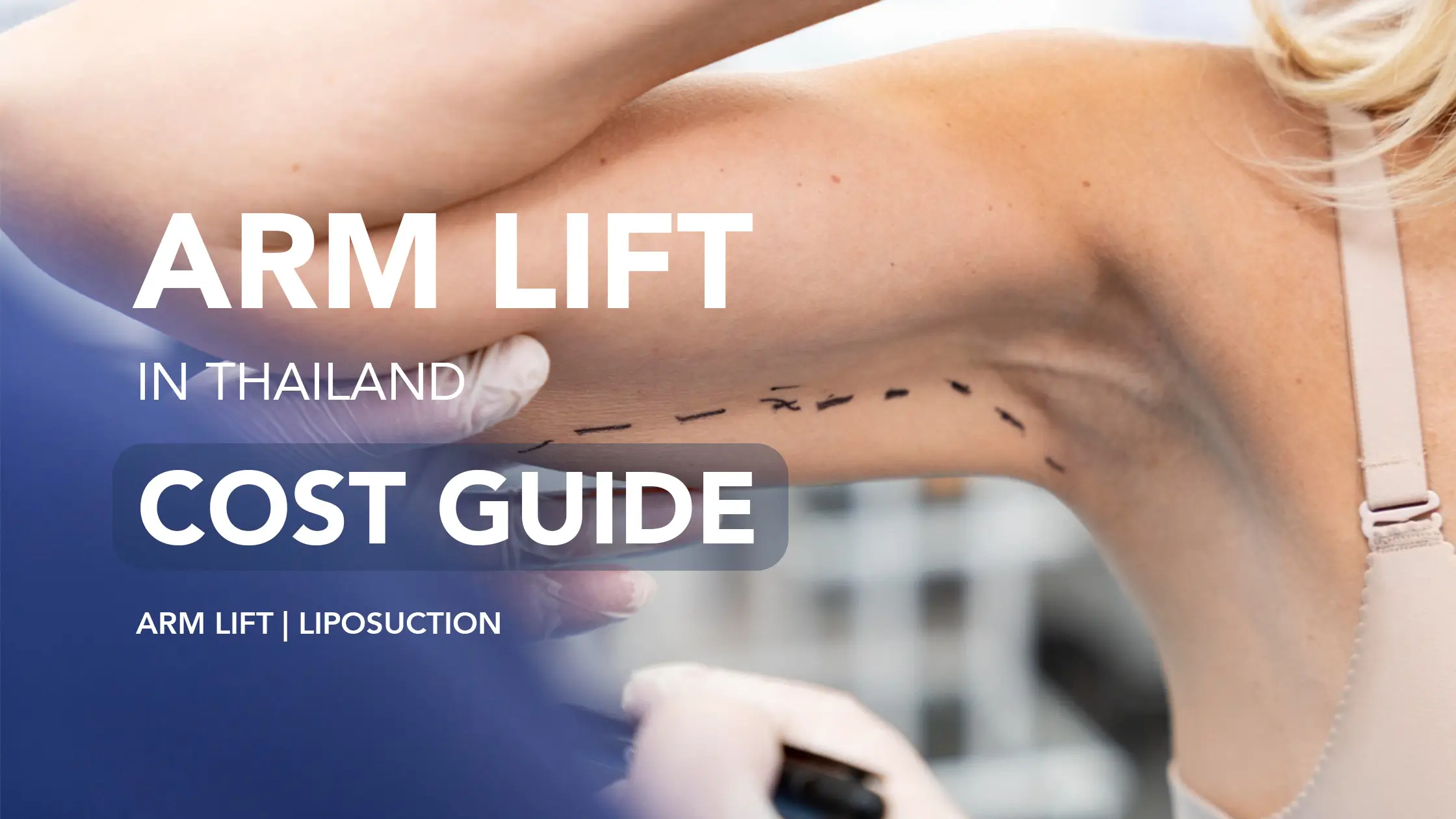
Weighing an arm lift against the scar it leaves?
A free video consultation gives you a straight assessment and a full quote.
Start with a free consultationAn arm lift in Thailand with Beauty Butler starts at THB 129,000, roughly USD 3,890. Adding liposuction to the same operation brings it to THB 164,000, and an extended arm lift with liposuction to THB 194,000. Those figures cover the surgery, a JCI-accredited hospital and the care around it.
For comparison, the American Society of Plastic Surgeons puts the average US arm lift at USD 6,192 (ASPS, 2026). That number is the surgeon's fee alone. ASPS says plainly on the same page that it excludes anaesthesia, operating room and other related costs.
Demand is climbing, too. Arm lifts in the United States grew 21% in 2025 (ASPS 2025 Procedural Statistics, published 1 September 2026). Neck lifts and thigh lifts rose alongside them. More people are losing significant weight, and more of them are asking what to do about the skin left behind.
This guide gives you the prices and the honest scar conversation. It also helps you work out whether you need an arm lift (brachioplasty) at all. Liposuction on its own may well do the job.
Key Takeaways
- An arm lift in Thailand starts at THB 129,000 all-in, against AUD 11,000 to 14,000 or roughly USD 9,000 to 12,500 all-in at home.
- The scar is permanent. ISAPS calls it "the principal trade-off" of the operation, and accepting it is formally listed as a candidacy criterion.
- Two years on, though, satisfaction is measurably high: 68 post-bariatric patients showed significant improvement on both BODY-Q and SCAR-Q (Barone et al., 2025).
- If your problem is mostly fat and your skin still has elasticity, liposuction alone may be enough. If it is mostly loose skin, there is no way around the incision.
- Australians with documented functional problems after major weight loss may claim a small Medicare rebate under MBS item 30169.
What an arm lift in Thailand costs in 2026
An arm lift is priced by how much work it involves. Two things drive that: whether liposuction is needed alongside the skin removal, and how far along the arm the correction has to run. Here are the four prices, all confirmed in Thai baht.
- Arm lift, standalone, no liposuction: THB 129,000 (approx. USD 3,890 / AUD 5,460 / £2,880 / NZD 6,590 / CAD 5,380)
- Arm lift with liposuction: THB 164,000 (approx. USD 4,940 / AUD 6,940 / £3,660 / NZD 8,380 / CAD 6,840)
- Extended arm lift with liposuction: THB 194,000 (approx. USD 5,850 / AUD 8,210 / £4,330 / NZD 9,910 / CAD 8,090)
- Liposuction of the arms, added to another procedure: THB 55,000 (approx. USD 1,660)
The last line matters if you are already planning something else. Say you are having a tummy tuck and want your arms slimmed at the same time. Arm liposuction added to that operation costs far less than a standalone procedure. You are already in theatre and already under anaesthetic.
Your surgeon confirms which of these you actually need at your free video consultation, before you commit to anything. You can also see the full arm lift packages and what each tier covers.
Currency conversions are approximate and move with the exchange rate. Always check the current rate before comparing. Your quote is confirmed in Thai baht.
Arm lift or liposuction: which one do you actually need?
This is the question that decides your price, your recovery and your scar. It has a clear clinical answer, and it is worth understanding before you speak to anyone. It is also the question some clinics answer in their own favour rather than yours.
The International Society of Aesthetic Plastic Surgery puts the distinction simply. Liposuction alone works "when excess fat is the primary concern, and the skin has enough elasticity to contract after fat removal." Skin removal, by contrast, is "generally required when loose skin is the main concern" (ISAPS).
So the honest triage runs like this.
If your arms are fat-dominant with good skin elasticity
Liposuction on its own can work, and it leaves only small puncture scars rather than a line along the arm. This is genuinely the better operation for the right patient. A 2022 study in Plastic and Reconstructive Surgery looked at severe fat with only moderate laxity. It found that liposuction with laser skin tightening was "a safe and effective alternative" to open surgery (PRS, PMID 35259140).
A simple self-test: pinch the underside of your upper arm, then let go. If the skin snaps back, elasticity is on your side.
If your arms are skin-dominant
There is no way around the incision. Loose skin does not respond to fat removal. Take fat out from under skin that has already lost its elasticity, and the looseness usually looks more obvious, not less. Excision is the operation, and the scar comes with it.
Be wary of anyone offering a "scarless arm lift" for significant skin excess. What is usually meant is liposuction, energy-based tightening, or both. For mild laxity that can be a reasonable plan. For a post-weight-loss arm, it is not.
Mini, full or extended?
The deciding factor is how far down your arm the loose tissue extends, not how short a scar you would prefer.
- Mini (short-scar) arm lift. Suits mild to moderate laxity confined to the upper arm, near the armpit. The scar sits largely hidden in the armpit crease.
- Full brachioplasty. Needed when looseness extends toward the elbow. The incision runs along the inner arm. As one UK surgical group puts it, this applies "regardless of how much you would prefer a shorter scar."
- Extended arm lift. Used when the excess continues past the armpit onto the side of the chest. The incision extends accordingly (ISAPS).
Most post-weight-loss patients land in the second group. A 2026 review in Aesthetic Plastic Surgery assessed liposuction-assisted traditional brachioplasty, with the scar placed in the groove along the inner arm. It concluded the technique "is effective for most post-bariatric patients," with only a minority needing anything more involved (Susini et al.).
Will an arm lift leave a scar? The honest answer
Yes, and it is permanent. ISAPS states it directly: "The principal trade-off of brachioplasty is a permanent scar in exchange for a more defined arm contour." Every patient considering this operation should read that sentence twice before going further.
Here is the part most pages leave out. ISAPS does not list the scar as a side effect or a disclaimer. It lists accepting the scar as a criterion for being a candidate at all. Good candidates, in its words, "understand and accept the location and length of the resulting scar."
That reframes the whole conversation. The question is not how bad the scar will be. It is this: would I trade a line on my inner arm for an arm shape I am happy with? Some people answer yes without hesitation. Others, honestly, should not have this operation. Both answers are fine, and it is far better to reach yours before a deposit than after.
Where the scar sits and how visible it is
The incision runs along the inner arm, in the groove beside the bicep. Placed there, it faces your body rather than the world. At rest, with your arms down, it is largely concealed. It is most visible when your arms are raised, in a swimsuit, or in strong overhead light.
There is some evidence on which shape patients prefer. A survey of around 135 people, published in Annals of Plastic Surgery, rated a straight inner-arm scar most favourably. Wavy or sinusoidal patterns were rated worst. The preference held across age and gender. That study is from 2013, so treat it as a useful signal rather than current practice.
How long the scar takes to settle
This is where expectations most often go wrong. The Aesthetic Society gives the clearest published timeline: "Your scars will be firm and pink for about six weeks. It will take at least nine to twelve months for the scars on your arms to flatten and lighten in colour" (The Aesthetic Society).
Nine to twelve months. Not six weeks, not three months. ISAPS adds that maturation "may continue for 12 months or longer." If you judge your result at week eight, you will be looking at a scar that has barely begun to change.
How often does scarring go badly?
Roughly one in ten. A 2022 meta-analysis in Plastic and Reconstructive Surgery, pooling 29 studies and 1,578 patients, found aberrant scarring in 9.9% of cases (95% CI 6.1 to 15.6). It was the single most common complication of the operation (Aljerian et al., PMID 34936607).
"Aberrant" covers scars that heal thickened, raised, widened or discoloured rather than settling into a thin pale line. It is more likely if you smoke, or if you have a history of keloid or hypertrophic scarring. It is also more likely if the wound is put under tension while healing. Two of those three you can influence.
What patients actually say two years later
This is the evidence almost nobody publishes, and it is the fairest answer to "will I regret it?"
A 2025 study in Aesthetic Plastic Surgery followed 68 post-bariatric brachioplasty patients for a mean of 24.4 months. It used two validated patient-reported questionnaires. BODY-Q measures satisfaction with body appearance. SCAR-Q measures how patients feel about the scar itself. Both improved significantly, BODY-Q at p=0.003 and SCAR-Q at p=0.0045. The authors reported that patients "did not express any noteworthy concerns" about the scar (Barone et al., 2025).
Hold the whole picture together, because all of it is true at once. The scar is permanent. It takes nine to twelve months to settle. Roughly one patient in ten gets a scar that does not heal as hoped. And two years on, measured satisfaction, including satisfaction with the scar, is high.
That is the trade-off, stated accurately. We would rather you weigh it properly than be reassured into an operation you have not thought through.
Thailand vs home: an honest price comparison
Comparing surgery prices across countries is harder than it looks, because quotes rarely cover the same things. The most common error, and one we see repeated across arm lift pages, is comparing a Thai all-in package against a foreign surgeon's fee. That understates the real gap, and any careful reader will spot it.
So here is like-for-like, with the source named and the inclusions stated each time.
United States
The ASPS average is USD 6,192. ASPS states on its own cost page that this figure "does not include anesthesia, operating room facilities or other related expenses" (ASPS). It is a surgeon's fee, not a total. Published all-in figures from US practices run higher: one Seattle clinic quotes USD 9,000 to 12,500 for the complete procedure.
Australia
Australia has the best-documented cost breakdown of the five markets we serve. One Australian body contouring practice publishes these component costs:
- Surgeon's fee, full brachioplasty: AUD 6,000 to 9,000
- Surgeon's fee, extended arm lift: up to AUD 10,000
- Overnight hospital stay: AUD 1,000 to 1,600
- Operating room time: AUD 1,200 to 1,500 per hour
- Anaesthetist: AUD 600 to 800 per hour
A Sydney practice quotes complete totals of AUD 11,000 to 14,000. Longer or more complex cases run higher still.
United Kingdom
The national private range is £4,760 to £6,783, covering all medical and nursing care during the procedure, hospital fees, in-hospital drugs and the surgeon's fee. It excludes assessments, tests and post-operative physiotherapy (privatehealth.co.uk, reviewed June 2025). Individual UK providers quote across a wider band, from around £4,500 for a mini procedure up to £11,331 at one private hospital group.
Canada
Canadian clinics commonly quote CAD 9,500 to 14,000, with one Ontario practice publishing CAD 15,900 plus HST. Provincial health insurance does not cover a cosmetic arm lift, and a 5% GST applies to elective cosmetic surgery.
New Zealand
We will be straight with you here. New Zealand has the thinnest published pricing of the five markets, and we are not going to invent a national range. One Hamilton surgeon publishes a surgeon's fee of NZD 7,500 to 9,000. That includes compression garments, all dressing changes, nursing care and six weeks of follow-up. Hospital, theatre and anaesthetic costs sit on top. If you are in New Zealand, ask for a written breakdown rather than a headline figure.
Does Medicare or the NHS help?
For most people, no. For some Australians, a little.
Australian Medicare does list a relevant item. MBS item 30169 covers removal of redundant non-abdominal skin and lipectomy. It applies "for functional problems following significant weight loss equivalent to at least 5 body mass index points." Weight must also have been stable for at least six months. The schedule fee is AUD 718.15, with a 75% benefit of AUD 538.65, current as at 1 July 2026 (MBS Online).
Read that carefully before getting your hopes up. The rebate is around AUD 539 against a procedure costing AUD 11,000 or more, so it moves the total by roughly 5%. It applies only to functional cases. You typically need documented problems such as recurrent skin infection, ulceration, hygiene difficulty or restricted movement, with conservative treatment already tried. A purely cosmetic arm lift does not qualify.
In the UK, the NHS does not fund cosmetic arm surgery. In Canada, provincial plans do not cover it. In the US, insurers treat brachioplasty as cosmetic apart from rare documented functional cases.
Why the price in Thailand is lower
It is a cost-base difference, not a quality difference. Surgical wages, hospital overheads and facility costs in Thailand are a fraction of those in Sydney, London or Toronto. The surgical standard is not what changes. Beauty Butler works only in JCI-accredited hospitals, which is the same international accreditation held by leading hospitals in Australia, the UK and the US.
You are paying for the same surgical skill in a different economy. That is the whole of it.
What is included in a Beauty Butler arm lift package
The figure in your quote is the figure you pay. Nothing is added once you land. A complete package covers:
- Your surgeon's fee, with a personally vetted, board-certified surgeon
- A JCI-accredited Bangkok hospital, all anaesthesia and operating costs
- Pre-surgery health checks and medical clearance in Bangkok
- At least one night in a private hospital room with nursing care
- Post-operative medication and your compression garment
- A personal English-speaking coordinator, from arrival through to your return home
- All airport transfers and in-Bangkok transport
- Five-star hotel and recovery-space accommodation, with daily breakfast
- Personal nurse visits at your hotel, daily to around day seven
- In-hotel lymphatic drainage massage with a dedicated therapist
- Curated outings paced to your recovery, and a Thailand travel eSIM
- Surgeon follow-up consultations after you return home, on demand
Your balance is due two weeks before surgery, not on arrival, so you are not travelling with large sums or handling payments while recovering.
One thing we will not overstate. We have no clinician based in Australia, New Zealand, the UK, the US or Canada. Once you fly home, your aftercare is the Beauty Butler team supporting you remotely, plus follow-up video consultations with your surgeon whenever you need them. That is a real and responsive arrangement. We want you to know exactly what it is, rather than picture local cover we do not provide.
Are you a candidate for an arm lift?
Most arm lift patients arrive after significant weight loss, whether through bariatric surgery, GLP-1 medication or sustained effort. You did the hard part. What is left is a mechanical problem that no amount of further training will solve. Skin stretched past its elastic limit does not retract.
ISAPS lists the criteria that matter:
- Stable weight. Six months of stability is the working standard among surgeons, and it is also what Australian Medicare requires for item 30169. Operating too early means removing skin you would have lost anyway, and risks a second procedure later.
- Loose skin or localised fat on the upper arms that has not responded to diet and exercise.
- Good general health, with any chronic conditions well managed.
- No nicotine use. Nicotine constricts the small blood vessels that feed a healing wound. It measurably raises the risk of poor healing and bad scarring.
- Realistic expectations, and acceptance of the scar's location and length.
A note on timing if you are still losing. There is no prize for going early. If you are on a GLP-1 medication and your weight is still moving, wait until it plateaus and holds. We would rather tell you to come back in eight months than operate on a shape that is still changing.
What are the risks of an arm lift?
Brachioplasty is a well-established operation, but it is real surgery and it has a real complication profile. The best available evidence is that 2022 meta-analysis of 29 studies and 1,578 patients (Aljerian et al.). Pooled rates were:
- Aberrant scarring: 9.9% (95% CI 6.1 to 15.6)
- Recurrent looseness: 7.8%
- Wound separation: 6.8%
- Seroma: 5.9% (95% CI 3.75 to 9.25)
- Infection: 3.6%
- Nerve-related problems: 2.5%
- Lymphoedema or lymphocele: 2.5%
- Skin necrosis or delayed healing: 2.3%
- Haematoma: 2.1%
What a seroma is, and why drains exist
At 5.9%, seroma affects roughly one patient in seventeen. It is worth understanding, because it is the complication most likely to affect your trip.
When skin is lifted away from the tissue underneath, the body fills the space with clear fluid. Usually it reabsorbs. Sometimes it collects into a soft, swollen pocket that you can feel moving under the skin. It is not dangerous in itself, but left alone it delays healing and can spoil the contour.
That is why your surgeon may place a small drain, a thin tube that lets fluid escape while the tissue planes stick back together (ASPS). It is also why your compression garment matters more than patients expect. If a seroma does form, the treatment is usually straightforward: your surgeon draws the fluid off with a fine needle, sometimes more than once.
Two weeks in Bangkok means this gets caught and dealt with while you are still under daily supervision. It does not become a problem at 30,000 feet.
ISAPS also lists asymmetry and lymphoedema, which the ASPS risk list omits. Ask your surgeon about both.
Recovery: what two weeks in Bangkok actually looks like
Plan on around two weeks in Thailand for an arm lift, with one to two nights in hospital at the start. Here is the published timeline, drawn mainly from The Aesthetic Society's aftercare guidance.
- Days 1 to 2. Bruising and swelling peak at 36 to 48 hours. Your arms are wrapped or in a compression garment from the moment you wake. Keep them elevated.
- Within about five days. Dressings come off at your first post-operative visit.
- Days 10 to 14. Swelling and bruising largely subside. Driving is usually cleared around day ten, and never within 24 hours of taking strong pain medication.
- Weeks 1 to 2. Most people are ready for desk work.
- Weeks 3 to 5. Some residual arm swelling can persist. Elevation shortens it.
- Four weeks. Exercise that stresses the arms stays off the table until at least here. Gentle cardio may resume around the one-month mark.
- Six weeks. Heavy lifting, jogging and contact sport are typically cleared. Scars are still firm and pink.
- Nine to twelve months. Scars flatten and lighten. This is when you judge the result.
Two practical points nobody mentions. First, your arms do most of the work of daily life. For the first week, you will be surprised by what you cannot do one-handed in a hotel room. That is exactly what the nurse visits and hotel-based support are for. Second, the compression garment is not optional decoration. Most surgeons advise wearing it around the clock, apart from bathing, for the first two to three weeks. Total wear is usually four to six weeks. It manages swelling and helps the tissue planes settle.
When can you fly home?
Your surgical team makes that call, individually, before you travel. We are not going to publish a number as though it were a medical standard, because there isn't one for brachioplasty specifically.
What we can explain is what your surgeon is weighing. Long-haul flights combine immobility, dehydration and cabin pressure. Recent surgery temporarily raises the risk of a blood clot forming in a deep vein. That risk is documented after body contouring, particularly in patients who have lost a lot of weight. An arm lift is lower risk in this respect than an abdominal procedure. Even so, the clearance comes from the surgeon who operated on you, not from a blog. Our two-week window is built so that clearance happens before your flight, not around it.
If you want the fuller picture, we cover when it is safe to fly home in detail.
Can you combine an arm lift with another procedure?
Often yes, and arm lift with a tummy tuck is the most commonly requested pairing. Combining saves you a second flight, a second recovery and a second set of travel costs. But the honest answer on safety is that the evidence genuinely conflicts, and you deserve both halves of it.
A 2016 analysis of 2,294 brachioplasties drew on a US insurance database. It found major complications in 1.3% of arm lifts performed alone, against 4.4% when combined with other procedures, a relative risk of 3.58. Male sex and a BMI of 30 or above also raised risk (Nguyen et al., Aesthetic Surgery Journal). That study used data from 2008 to 2013, so it is dated, but it remains the largest clean comparison available.
Against that, a multipractice brachioplasty cohort published in Plastic and Reconstructive Surgery found that adding concurrent procedures did not significantly increase complications.
Two things are worth holding onto. First, "risk triples" is a misleading headline on its own. The base rate is low. Going from 1.3% to 4.4% is a tripling of a small number. The authors of the larger study described the overall rates as "much lower than previously reported." Second, the studies miss the variable that matters most in practice. That is the surgical team's experience with your specific combination, plus the total time you spend under anaesthetic.
So the useful question at your consultation is not whether these can be combined. Ask how often your surgeon does these two together. Then ask how long you will be asleep. We go through this properly in our guide to combining more than one procedure safely.
Choosing safely: the questions that matter
Before booking an arm lift anywhere, confirm these six things.
- The surgeon is board-certified and performs brachioplasty regularly, not occasionally.
- You have seen before-and-after photos of arms like yours, at a similar stage of weight loss. Ask for photos at least twelve months post-operative, so the scars have matured.
- The hospital is internationally accredited. JCI is the benchmark.
- You can meet your surgeon before paying anything.
- The plan names the technique and the expected scar length, and explains why that technique was chosen for you.
- You know who you call at week three, when you are home and something looks different.
Beauty Butler works only with personally vetted board-certified surgeons operating in JCI-accredited Bangkok hospitals. Every patient meets their surgeon on a free video consultation, before any money changes hands. You make this decision with evidence, not trust alone.
An arm lift is a straightforward trade with a clear answer on both sides. Perhaps the shape of your arms is keeping you out of sleeves you want to wear. If you have also looked honestly at the scar and decided it is worth it, this is typically an excellent option. If you are not sure about the scar yet, that is useful information too, and a consultation is the right place to work it out.
Ready to see what this looks like for you? Start with a free consultation. The next step costs nothing.
Frequently asked questions
How much does an arm lift cost in Thailand?
An arm lift in Thailand with Beauty Butler starts at THB 129,000, roughly USD 3,890. With liposuction it is THB 164,000, and an extended arm lift with liposuction is THB 194,000. Arm liposuction added to another procedure is THB 55,000. All prices cover surgeon, JCI-accredited hospital and aftercare.
How does that compare to my home country?
In the US, the ASPS average of USD 6,192 is the surgeon's fee alone, before anaesthesia and facility costs; all-in US quotes run around USD 9,000 to 12,500. Australian totals are commonly AUD 11,000 to 14,000. The UK private range is £4,760 to £6,783, and Canadian clinics quote CAD 9,500 to 14,000.
Does an arm lift leave a big scar, and is it permanent?
Yes, and yes. ISAPS calls the permanent scar "the principal trade-off" of the operation. It runs along the inner arm, mostly hidden when your arms are down. Scars stay firm and pink for about six weeks and take at least nine to twelve months to flatten and lighten.
Can liposuction alone fix "bat wings"?
Sometimes. ISAPS says liposuction alone works when excess fat is the main problem and the skin still has enough elasticity to contract afterwards. If loose skin is the main problem, which is usual after major weight loss, skin removal is required and liposuction alone will make the looseness more obvious.
What is the difference between a mini, full and extended arm lift?
It depends on how far the loose tissue extends, not on scar preference. A mini suits mild laxity near the armpit. A full brachioplasty is needed when looseness reaches toward the elbow. An extended arm lift is used when the excess continues onto the side of the chest.
Does Medicare or the NHS cover an arm lift?
Rarely. Australian Medicare item 30169 covers skin removal for functional problems after weight loss of at least 5 BMI points, with weight stable six months. The benefit is AUD 538.65 against a procedure costing AUD 11,000 or more. The NHS, Canadian provincial plans and US insurers do not fund cosmetic arm lifts.
How long is recovery, and how long do I need in Thailand?
Plan on about two weeks in Thailand, including one to two hospital nights. Most people manage desk work at one to two weeks. Exercise stressing the arms waits four weeks, and heavy lifting six. Final scar appearance takes nine to twelve months.
What is a seroma, and how common is it?
A seroma is a pocket of clear fluid collecting under the lifted skin. Pooled data from 1,578 patients puts the rate at 5.9%, roughly one in seventeen. It is why a small drain is often placed and why your compression garment matters. Treatment is usually a simple needle drainage.
Do I need to lose weight first, and how long must my weight be stable?
Yes, reach your target weight first. Six months of stable weight is the working standard among surgeons, and Australian Medicare requires the same for item 30169. Operating while your weight is still moving risks removing skin you would have lost anyway, and may mean a second procedure.
Can I combine an arm lift with a tummy tuck in one trip?
Often, yes, and it is the most requested pairing. The evidence on added risk conflicts: one 2,294-patient analysis found major complications rising from 1.3% alone to 4.4% combined, while a multipractice cohort found no significant increase. Both base rates are low. Your surgeon decides based on your health and total operating time.
References
- International Society of Aesthetic Plastic Surgery: Arm Lift (technique, candidacy, the scar trade-off)
- American Society of Plastic Surgeons: Arm Lift Cost and 2025 Procedural Statistics
- The Aesthetic Society: Upper Arm Lift Aftercare and Recovery (recovery and scar timeline)
- Aljerian A. et al., Complications in Brachioplasty: a systematic review and meta-analysis, Plastic and Reconstructive Surgery, January 2022 (29 studies, 1,578 patients)
- Barone M. et al., Patient-reported outcomes after post-bariatric brachioplasty, Aesthetic Plastic Surgery, 2025 (68 patients, mean 24.4-month follow-up, BODY-Q and SCAR-Q)
- Nguyen L. et al., Incidence and Risk Factors of Major Complications in Brachioplasty: Analysis of 2,294 Patients, Aesthetic Surgery Journal, 2016
- Australian Government Department of Health: MBS item 30169 (effective 1 July 2026)
- privatehealth.co.uk: Arm Lift Costs (UK national private range, reviewed June 2025)
.webp)

The results you want — for a fraction of the cost.
Thailand's top surgeons, concierge care from first hello to flight home, and no hidden prices. Curious what's possible for you?
Explore your optionsTrue luxury is peace of mind, especially when you are far from home.