

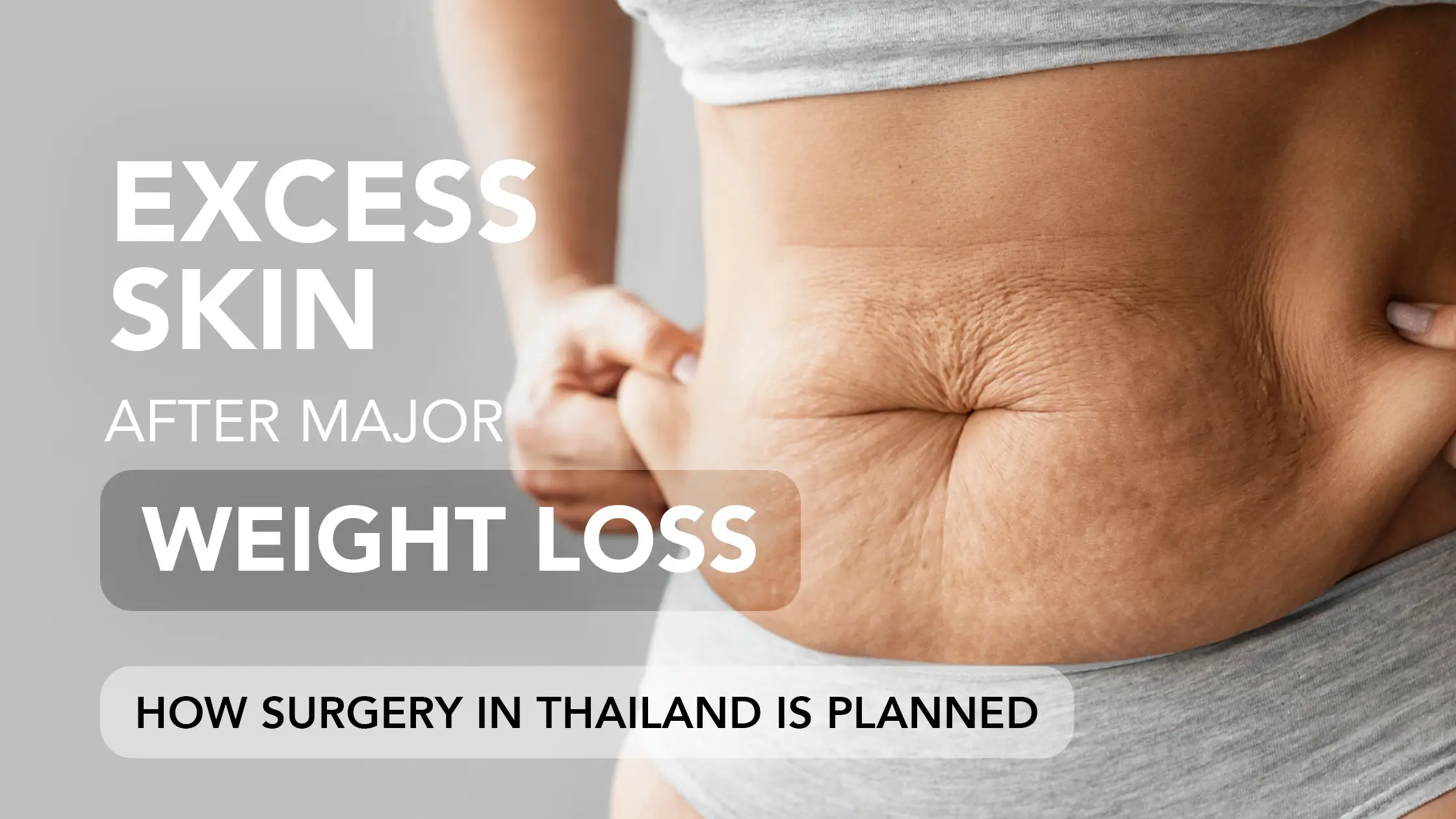
Planning skin removal after major weight loss?
A free video consultation maps out the stages, the timing and the full cost.
Start with a free consultationRemoving a large amount of loose skin after major weight loss may be done in one longer operation, or split across two or three. Which one suits you depends on your case and on your surgeon's experience with these operations. There is no fixed rule, and anyone who gives you one from a web page is guessing. How that plan is built for you matters more to your result than any single price.
You have done the hard part already. Losing 30, 50 or 80 kilos takes years of discipline, and the skin left behind is not a failure of that effort. It is simply what happens when tissue has been stretched for a long time. This guide explains how that surgery is actually planned in Thailand. When you are ready, what your blood work needs to show, which operation comes first, what can honestly go wrong, and what it costs.
Key Takeaways
- Whether it is one operation or several depends on your case and your surgeon's judgement. There is no fixed rule.
- Most surgeons want you weight-stable for at least six months, and most patients reach that point 12 to 24 months after bariatric surgery (Cleveland Clinic).
- Complication rates after body contouring in major weight loss patients run between 20 and 70 percent (ASPS, 2026). Nutrition is one of the few levers you control.
- Beauty Butler prices a thigh lift from THB 165,000 and an arm lift from THB 129,000, all-inclusive.
- Your surgeon decides when you can fly, not a calendar. Drains often stay in for one to three weeks.
One operation or several?
This is the first real decision, and the honest answer is that it depends on your case and your surgeon.
Operating time is one of the things a surgeon weighs. Longer sessions carry more physiological load: blood loss, body temperature, fluid shifts, and the risk of a clot forming in the leg. Post-weight-loss patients start from a harder baseline than a routine cosmetic patient, so the assessment matters more.
For scale, a standalone tummy tuck usually takes two to four hours. A circumferential lower body procedure takes four to six (American Board of Cosmetic Surgery).
Those are guides, not limits. Some surgeons routinely perform longer combined sessions, safely, and ours is one of them. What makes that reasonable is not ambition. It rests on four things. The surgeon's own volume in these operations. A dedicated anaesthetic team. A JCI-accredited hospital with intensive care on site. And a patient whose blood work and general health support it. Where those conditions are not met, the work is split.
So the question to ask is not "how many hours?" on its own. Ask why your surgeon is proposing this particular plan for you, what your own risk factors are, and what would make them split it. A surgeon who can answer that has thought about your case. If you are weighing what can reasonably share one anaesthetic, we have written separately about planning more than one procedure in a single trip.
If you do need more than one operation, what is the order?
Your surgeon decides this, and it is genuinely individual. Where the abdomen and lower body are the main problem, they are often addressed first, because lifting the lower body changes the tension on everything above it. A patient whose main complaint is their arms may reasonably start there instead.
The interval between operations is a clinical judgement too, not a fixed number. It depends on how you heal, how settled your weight is, and what the next stage involves. What matters is that your surgeon can explain the order they are proposing and why it suits your case.
When are you actually ready for surgery?
Most surgeons want you weight-stable for at least six months, and most patients reach that point 12 to 24 months after bariatric surgery (Cleveland Clinic). Those are two different tests, and both have to pass. Six months of stability at month nine still counts.
Operating while you are still losing is the most common planning mistake. Skin removed at 95 kilos will be loose again at 80. Operating after a regain is no better, because the closure comes under tension and tension is what makes wounds separate.
Stability means your weight has genuinely settled, not that you have stopped weighing yourself. It also means you are not planning another push, and not planning a pregnancy in the near term (Cleveland Clinic).
Are you earlier in the journey, still considering gastric sleeve surgery in Thailand? Then it is worth knowing now that skin surgery usually sits a year or more behind it. Planning both from the start is easier than discovering the gap later.
Does it matter how you lost the weight?
This is the most interesting finding of the last year, and it goes against what most people assume. A cohort of 1,002 body contouring patients was studied. Complication rates did not differ between patients who lost weight through bariatric surgery, GLP-1 medication, or diet and exercise (Aesthetic Surgery Journal, 2026).
What did predict complications was different: your BMI on the day of surgery, and whether you have diabetes. Each extra point of BMI raised the odds slightly, and diabetes raised them by roughly 60 percent.
That is a genuinely useful reframe. The question at consultation is not "how did you lose it". It is "where are you now, and is your diabetes well controlled". With 82 percent of surgeons reporting GLP-1 consultations in 2025 (ASPS, 2026), a lot of people need to hear it.
What your blood work needs to show before we book you
This is the section almost no other page will give you. Enhanced nutrition should start weeks before surgery, and a standard multivitamin may not be enough to correct every deficiency (ASPS, 2026). Skin removal is a large wound. Wounds are built from protein, iron and vitamins, and after bariatric surgery you may be short of all three.
Beauty Butler arranges a pre-surgery health check and medical clearance for every patient. For post-weight-loss cases, that check matters more than usual. A deficiency picked up six weeks early is fixable. One picked up on the day is not.
The protein target
Protein is the single biggest lever you control. After bariatric surgery the accepted minimum is 60 grams a day, and the expert recommendation for healing is 1.5 grams per kilo of ideal body weight (Nutrients, 2021). Where your BMI is above 27, that target is calculated against a BMI of 27 rather than your current weight.
In practice that often means more protein than you are used to, taken in smaller, concentrated servings through the day. That pattern is also what a reduced stomach tolerates best. Our guide to eating well while you heal covers the same ground for the recovery period.
The pre-operative panel
These are the bloods a post-weight-loss case should have checked before a date is confirmed:
- Albumin, pre-albumin, transferrin and total protein. These show whether your body has the raw material to build a healed wound.
- Ferritin and haemoglobin. Iron deficiency and anaemia are common after bariatric surgery and both slow healing.
- Vitamin B12 and folate. Absorption of both is reduced after some bariatric procedures.
- Vitamin D. Frequently low, and straightforward to correct with enough notice.
A low result is not a refusal. It is a delay, usually of a few weeks, while it is corrected. That is a far better conversation than a wound that will not close in a hotel room in Bangkok. Smoking is the other hard prerequisite, because it directly impairs blood supply to healing skin.
What each operation actually removes
Post-weight-loss surgery has a confusing vocabulary, and the names matter because they describe genuinely different operations. Here is the landscape in plain English, including the operations we do not coordinate, so you can read any quote properly.
- Abdominoplasty, or tummy tuck. Removes excess skin, repairs separated abdominal muscle and repositions the navel.
- Panniculectomy. Removes only the apron of skin and fat below the navel. No muscle repair, no navel repositioning. It is a functional operation, usually done for skin infection or difficulty moving. We do not offer it as a separate procedure.
- Fleur-de-lis abdominoplasty. Adds a vertical midline excision to the horizontal one, used where there is a pre-existing midline scar or severe side-to-side excess. Also not something we coordinate.
- Lower body lift, or belt lipectomy. Removes skin and fat all the way around the body above the belt line, lifting the buttocks and outer thighs with it. We offer this as the full 360 tummy tuck.
- Upper body lift. Addresses the upper back, the roll under the arm and usually the breast. Again, not part of what we coordinate, though the individual components often are.
That distinction explains most of the price confusion online. A quote for skin removal in Thailand can range from around USD 2,500 to USD 15,000, and those cannot be the same operation. The low figures are almost always a panniculectomy or a standard tummy tuck under a grander name.
The abdomen and lower body
The full 360 tummy tuck is the operation most post-weight-loss patients are actually looking for when they search for a body lift. It works circumferentially, around the flanks and lower back, not just the front. Beauty Butler prices it from THB 269,000, all-inclusive. Adding 360 liposuction brings it to THB 409,000.
We are not going to repeat the abdominal pricing here, because it belongs in one place. If the abdomen is your main concern, read what a tummy tuck costs in Thailand for the full breakdown of mini, full, extended and 360 options.
Thighs, arms and back
These are the areas with no dedicated page on our site yet, so here are the prices in full:
- Thigh lift: THB 165,000 (about USD 4,970 or AUD 6,980)
- Thigh lift with liposuction: THB 239,000
- Extended thigh lift with liposuction: THB 259,000
- Circumferential thigh lift with liposuction: THB 325,000
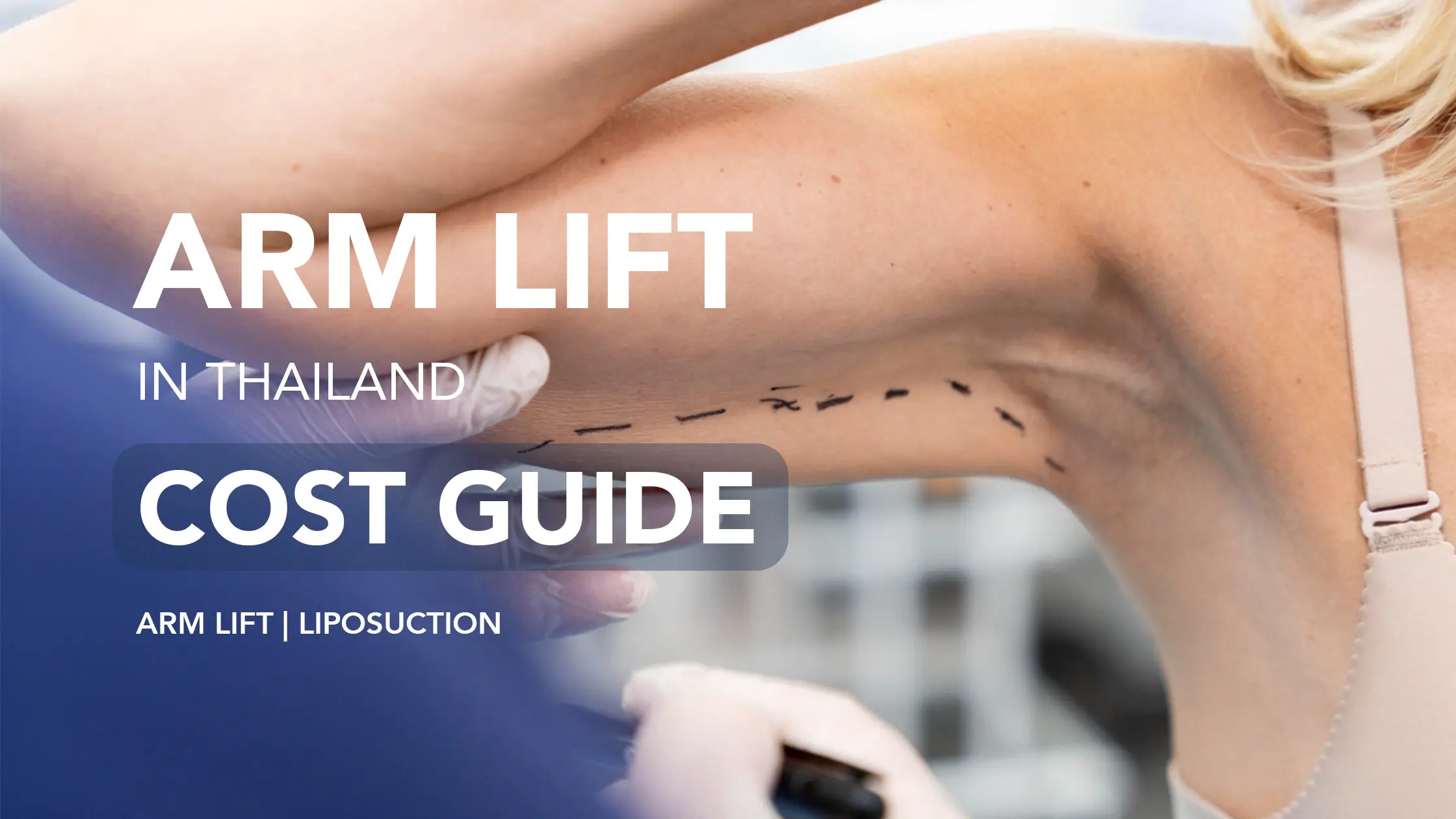
- Arm lift, on its own: THB 129,000 (about USD 3,890 or AUD 5,460)
- Arm lift with liposuction: THB 164,000
- Extended arm lift with liposuction: THB 194,000
- Braline back lift, including upper and middle back liposuction: THB 238,000
- Mons pubis lift: THB 69,000
Every figure covers your surgeon and a JCI-accredited hospital. It also covers at least one night in a private room, your recovery hotel, nurse visits, medication and your compression garment. Currency conversions are approximate and move with the exchange rate. Your quote is confirmed in Thai baht.
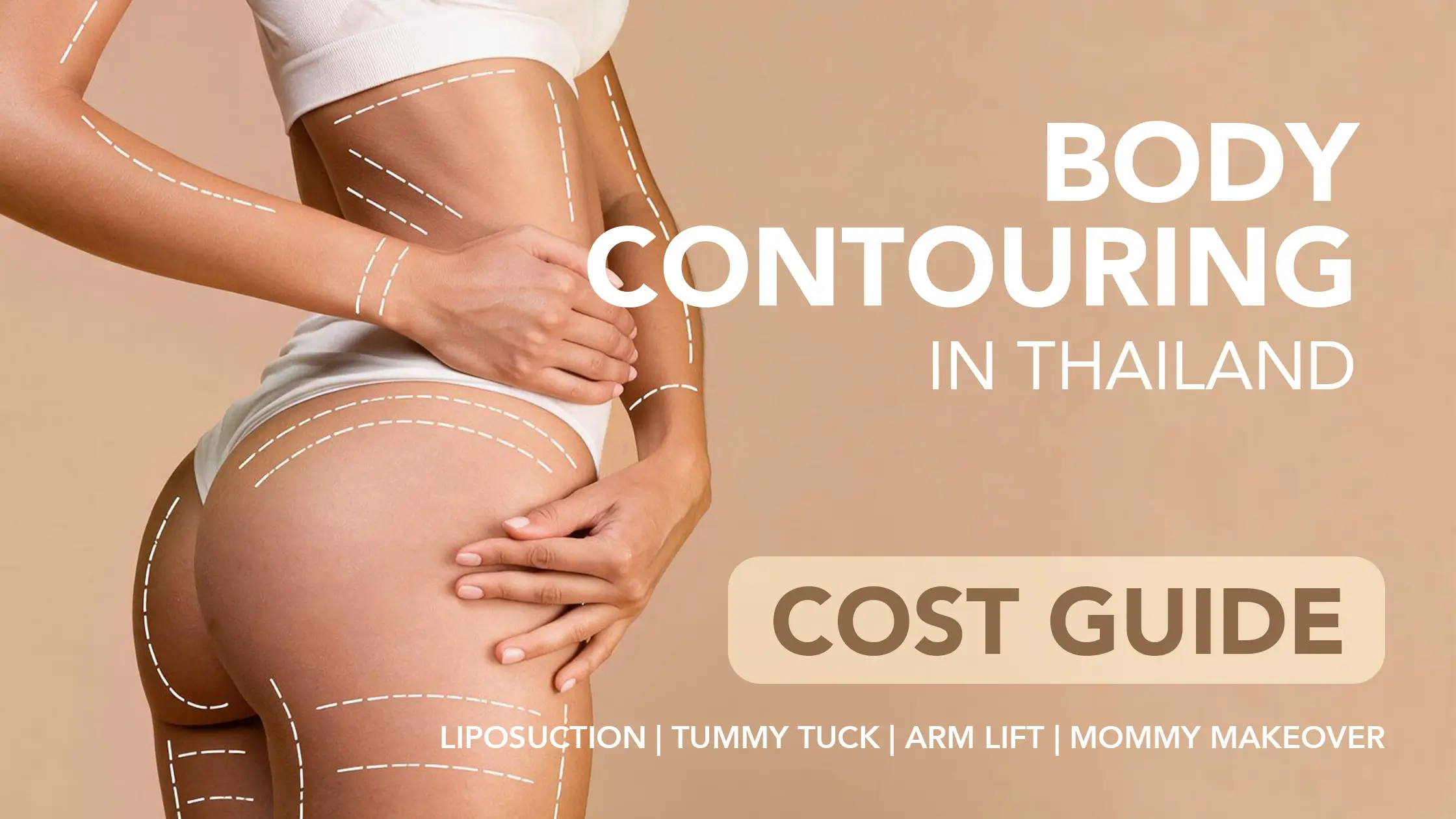
If arms are your priority, we have covered an arm lift after weight loss in much more detail, including scar placement. For the wider picture of how these procedures fit together, our guide to body contouring in Thailand is the place to start.
How risky is skin removal, honestly?
We would rather you heard this from us than found it later. Complication rates after body contouring in major weight loss patients run between 20 and 70 percent (ASPS, 2026). That is far higher than routine cosmetic surgery, and nutritional deficiency is one of the reasons why.
Most of those complications are wound problems rather than emergencies. The 1,002-patient cohort published in 2026 breaks them down by operation (Aesthetic Surgery Journal, 2026):
- Thigh lift: 36.1 percent, the highest of any area. Most of it is wound separation, at 25.3 percent.
- Breast procedures: 18.4 percent.
- Panniculectomy: 17.4 percent, mostly wound separation, infection, seroma and bruising.
- Arm lift: 11.9 percent, the lowest.
Thighs are the problem area, and the reason is mechanical. The inner thigh is a mobile, moist, high-tension part of the body that you cannot rest. An older and widely quoted series put the overall thigh lift complication rate at 68 percent. Six percent of those patients needed further surgery (Plastic and Reconstructive Surgery, 2015).
Both numbers are real. They differ because they count different things: the older series recorded every minor wound issue, including ones that healed on their own with dressings. Read together, they say something clear. A thigh lift very often has a bumpy healing course, and it is rarely serious. That is why thighs need the most realistic expectations of any area.
Choosing where you have this done matters more here than for a simple procedure. Our board-certified surgeons operate in JCI-accredited private hospitals, and every case is planned around one question: what is safe to do in one sitting.
Will Medicare or the NHS pay for any of it?
Sometimes, and only for the functional part. Australian Medicare item 30177 covers lipectomy for excess abdominal skin after significant weight loss, but only when all three conditions are met (MBS Item 30177):
- Intertrigo or another skin condition that risks the skin breaking down, which has failed three months of conventional treatment.
- Redundant skin that interferes with your activities of daily living.
- Weight stable for at least six months.
Note what that does not cover: thighs, arms, back or anything cosmetic. It is an abdominal item, for a medical problem.
In the UK, skin removal is not routinely commissioned by the NHS. Where funding is granted, it is usually an apronectomy on functional grounds rather than a full abdominoplasty. Local policies vary. Most require a sustained BMI under 30, documented failure of conservative measures, photographic evidence and prior approval (Cheshire and Merseyside ICB).
In the United States, most health insurance does not cover body lift surgery or its complications (ASPS). A pannus that genuinely interferes with daily activity is the usual exception.
It is worth applying if you qualify. Most people reading this will not, which is the honest reason private surgery gets considered at all.
How the private cost compares
For a like-for-like comparison, the thigh lift is the cleanest, because nobody bundles it:
- Thailand, with Beauty Butler: THB 165,000, about AUD 6,980 or USD 4,970, covering surgery, hospital, hotel and aftercare.
- Australia: a thigh lift starts from around AUD 18,800, and a full body lift from around AUD 43,100, for the surgery alone (Plastic Surgery Hub, 2026).
- United Kingdom: a full thigh lift starts from around £7,500 and a body lift from around £18,000 (Centre for Surgery, 2026).
- United States: the average surgeon's fee alone for a lower body lift is USD 11,397, before anaesthesia or facility costs (ASPS).
We have left New Zealand and Canada out of that list on purpose. We could not find a price source for either market that we would be willing to stand behind. We would rather show you a gap than a guess.
The gap is structural, not a compromise on quality. Thai surgical wages and hospital overheads are lower, the exchange rate does the rest, and our surgeons operate in internationally accredited private hospitals.
When can you fly home after a big skin removal?
Here is where we part company with most of what you will read. The only aviation authority guidance we can point to says travel should be avoided for 10 days following abdominal surgery (UK Civil Aviation Authority). That guidance was written for general abdominal surgery, not for a circumferential case with drains still in.
You will see "four to six weeks" quoted confidently on a lot of clinic websites. We have not been able to trace it to any medical authority, so we are not going to present it to you as one.
What we can tell you is concrete:
- The CAA's 10 days is a floor, not a target, and it is not specific to this operation.
- Drains usually stay in for one to three weeks after a large skin removal (Cleveland Clinic).
- Surgeons often advise longer than the CAA minimum for large circumferential cases.
- Clearance to fly is a decision your surgeon makes about you, after seeing how you are healing.
In practice, most of our post-weight-loss patients plan a longer stay than they first expect. That is also why the recovery period is managed rather than left to you. A nurse visits you at your hotel, daily through the first week. Lymphatic drainage massage is arranged in your room by a separate therapist. Our full timeline for when it's safe to fly home goes into more detail.
What happens after you land back home
We want to be straightforward about this, because it is the question that deserves a real answer. Beauty Butler does not have a clinician based in Australia, New Zealand, the UK or North America. There is no local GP arrangement, and we are not going to imply one.
What you do have is our team, reachable remotely for as long as you need us. You also get follow-up video consultations with your surgeon on demand after you return. If something concerns you at week three, you send a photo and you get a surgical opinion, not a call centre. For anything needing hands-on care, that will be your own GP or local practice, and we will brief them with everything they need.
Putting your own plan together
Most people arrive at this decision with one question and leave with a plan. That is normal, and it is the right direction of travel. What that plan looks like, one operation or several, is not something anyone can tell you from a web page. It comes out of your surgeon's assessment of your case.
If your plan does involve more than one trip, the gap between them is useful. You have time to keep your protein up, correct any deficiency, and see how your body settles.
The next step costs nothing. A free video consultation with the surgeon, before any commitment, will tell you what your own sequence should be and what is realistic in one sitting. Bring your recent blood results if you have them, and your weight history. That is what turns a guess into a plan.
Frequently asked questions
How long after gastric sleeve surgery can I have excess skin removed?
Most surgeons want you weight-stable for at least six months first, and most patients reach that point 12 to 24 months after their bariatric surgery. The two tests are separate, so six months of genuinely settled weight is the one that matters most. Operating while you are still losing means the skin will be loose again later.
Can it all be done in one operation?
Often yes. It depends on how much needs removing, your own health, and your surgeon's experience with these operations. Our surgeon regularly performs longer combined sessions, with a dedicated anaesthetic team and intensive care on site. Where that is not appropriate for your case, the work is split. Your surgeon decides at consultation.
How much does excess skin removal cost in Thailand?
With Beauty Butler, a thigh lift is THB 165,000 and an arm lift THB 129,000, rising to THB 239,000 and THB 164,000 with liposuction. A braline back lift is THB 238,000 and a mons pubis lift THB 69,000. Every price covers surgery, a JCI-accredited hospital, your recovery hotel and aftercare. Abdominal procedures are priced separately in our tummy tuck guide.
Is skin removal riskier than ordinary cosmetic surgery?
Yes, measurably. Complication rates after body contouring in major weight loss patients run between 20 and 70 percent, compared with far lower rates for routine cosmetic procedures. Most are wound-healing problems rather than emergencies. Thigh lifts carry the highest rate, at 36.1 percent in a 2026 cohort of 1,002 patients, and arm lifts the lowest at 11.9 percent.
Does it matter whether I lost the weight with surgery, a GLP-1 or diet?
Apparently not. A 2026 cohort of 1,002 patients found complication rates did not differ between bariatric surgery, GLP-1 medication and lifestyle weight loss. What did predict complications was BMI on the day of surgery and whether the patient had diabetes. So the useful conversation is about where you are now, not how you got here.
What blood tests do I need before surgery?
A post-weight-loss case should have albumin, pre-albumin, transferrin and total protein checked, plus ferritin, haemoglobin, vitamin B12, folate and vitamin D. These show whether your body can build a healed wound. A low result usually means a short delay while it is corrected, not a refusal, which is why we check weeks ahead rather than on arrival.
How much protein should I be eating before surgery?
The accepted minimum after bariatric surgery is 60 grams a day, and the expert recommendation for healing is 1.5 grams per kilo of ideal body weight. Where your BMI is above 27, the target is calculated against a BMI of 27. Smaller, concentrated servings through the day work best with a reduced stomach.
How long do drains stay in, and when can I fly home?
Drains usually stay in for one to three weeks after a large skin removal. The UK Civil Aviation Authority advises avoiding travel for 10 days after abdominal surgery. That guidance was written for general surgery, not a large circumferential case. Your actual clearance to fly is a decision your surgeon makes after seeing how you are healing.
Will Medicare or the NHS pay for skin removal?
Only for the functional part, and only if you qualify. Australian Medicare item 30177 covers abdominal lipectomy under three conditions. You need a skin condition that failed three months of treatment, skin that interferes with daily activities, and six months of stable weight. The NHS does not routinely commission skin removal, and where it does, it is usually an apronectomy.
References
- Cleveland Clinic: Excess Skin Removal and Lower Body Lift
- American Society of Plastic Surgeons: Nutrition recommendations support healing after body contouring surgery (August 2026)
- American Society of Plastic Surgeons: 2025 procedural statistics release and Body Lift Cost
- Aesthetic Surgery Journal: Complications after body contouring by weight-loss method, n=1,002 (2026)
- Plastic and Reconstructive Surgery: Medial thigh lift in the massive weight loss population (2015)
- PRS Global Open: Body contouring in massive weight loss patients, VTE chemoprophylaxis review (2021)
- Nutrients: Protein requirements after bariatric surgery (2021)
- American Board of Cosmetic Surgery: Skin removal after weight loss surgery
- Australian Government: MBS Item 30177
- Cheshire and Merseyside ICB: Abdominal apron policy CLIN099
- UK Civil Aviation Authority: Surgical conditions guidance
- Plastic Surgery Hub: Body surgery prices in Australia (2026)
- Centre for Surgery: Cosmetic surgery costs (2026)
This guide is informational and is not medical advice. Beauty Butler is a medical tourism coordination and concierge agency. We do not perform surgery. Discuss your own case with a qualified surgeon, which we arrange free of charge before any commitment.



The results you want — for a fraction of the cost.
Thailand's top surgeons, concierge care from first hello to flight home, and no hidden prices. Curious what's possible for you?
Explore your optionsTrue luxury is peace of mind, especially when you are far from home.