
.webp)
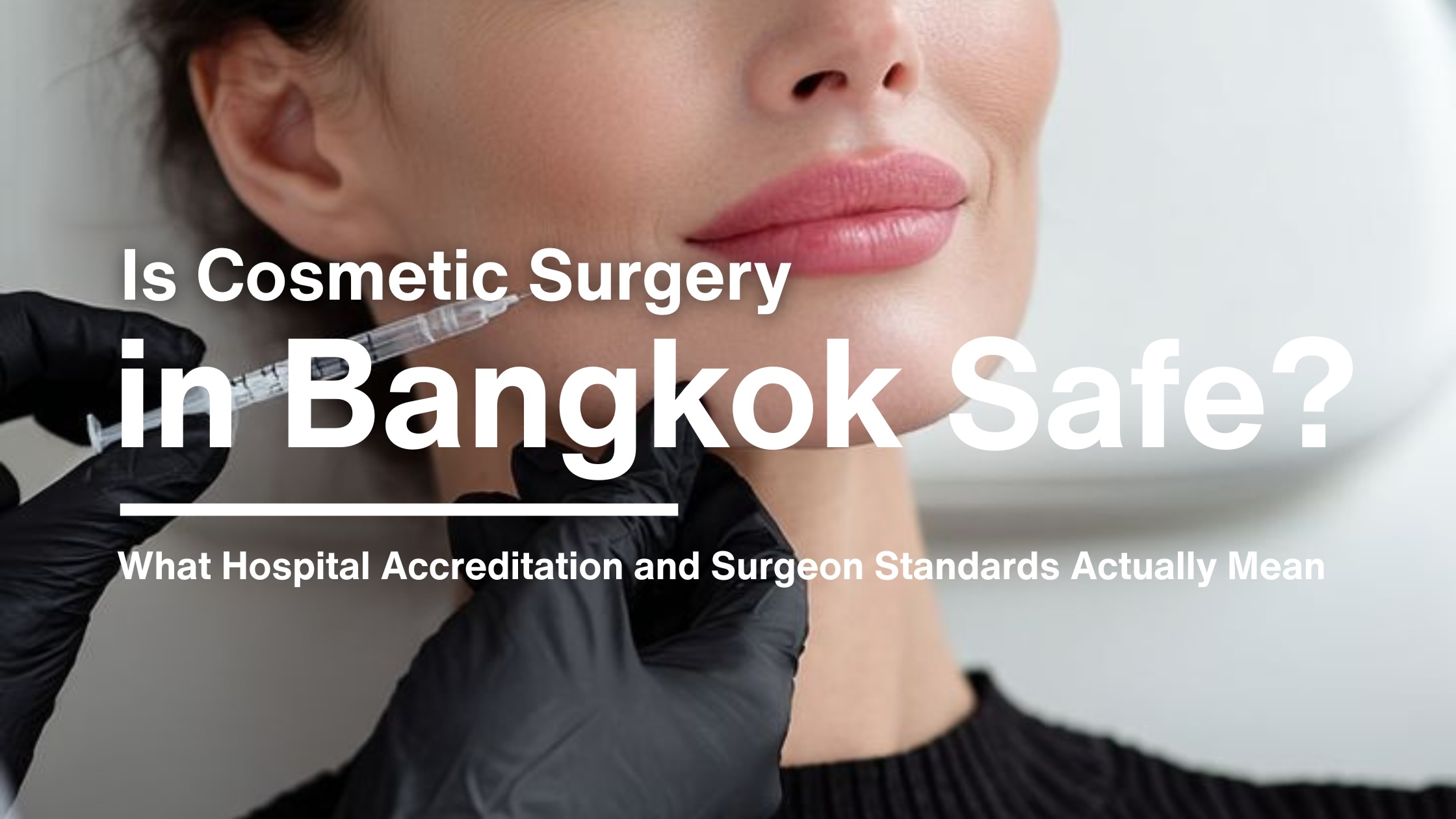
Safety is the first real question most international patients have when they start researching cosmetic surgery in Bangkok. It often goes unasked in consultations, but it shapes every decision made before booking.
The honest answer is this: Bangkok has some of the most capable cosmetic surgeons in the world, and its leading hospitals meet international accreditation standards that many Western facilities also strive to achieve. But the standard is not uniform across every clinic or provider. Knowing what to look for, and what the accreditations actually mean, is how you make the distinction.
What Hospital Accreditation Actually Means
The most recognised international standard for hospital quality is Joint Commission International accreditation, commonly referred to as JCI. JCI is an independent, non-profit organisation based in the United States that evaluates hospitals against a rigorous set of patient safety, clinical quality, and operational standards.
Achieving JCI accreditation is not a formality. It requires hospitals to demonstrate consistent compliance across hundreds of standards covering infection control, surgical safety protocols, patient rights, staff qualifications, medication management, and quality improvement processes. Hospitals are evaluated on-site by trained assessors and must maintain their standards to retain accreditation over time.
Several of Bangkok's major hospitals hold JCI accreditation. This includes hospitals that regularly perform cosmetic procedures for international patients. When a hospital is JCI-accredited, it means the facility has been independently verified against the same benchmark used to evaluate leading hospitals in Australia, the United States, and the United Kingdom.
Bumrungrad International Hospital, Bangkok Hospital, and Samitivej Hospital are among the most well-known JCI-accredited facilities in Bangkok. If accreditation is important to you — and it should be — confirming whether your procedure will be performed in a JCI-accredited facility is a reasonable and straightforward question to ask.
Surgeon Training and Qualifications
Hospital accreditation covers the facility. Surgeon qualification is a separate and equally important consideration.
Thailand's leading cosmetic surgeons are trained through pathways that frequently include postgraduate study or fellowship programmes in the United States, the United Kingdom, South Korea, or Europe. Board certification in Thailand is overseen by the Medical Council of Thailand and the Royal College of Surgeons of Thailand. These are nationally recognised bodies that set minimum standards for surgical training, examination, and ongoing professional development.
The practical result is that a well-qualified Thai cosmetic surgeon performing breast augmentation, facelift, or body contouring procedures has often trained in an international environment, performs their specialised procedures at high volume, and holds credentials that are meaningfully comparable to those of surgeons practicing in Australia.
High surgical volume matters specifically because cosmetic surgery outcomes are closely linked to experience. A surgeon who performs several hundred breast augmentations a year develops a precision and consistency that a lower-volume practitioner cannot replicate at the same rate. This is true regardless of country.
What the Safety Concern Is Really About
When patients ask whether surgery in Bangkok is safe, they are rarely asking about the technical capability of surgeons or the quality of the facilities. They are asking whether the full experience is safe, whether they will be looked after, whether they will have someone to contact if something does not feel right, and whether the system around their procedure is organised and accountable.
This is the more nuanced version of the question, and it deserves a direct answer.
The safety of your surgery experience in Bangkok is significantly shaped by how the experience is managed around the procedure itself. Patients who book through an organised concierge service that handles surgeon matching, pre-operative preparation, logistics, and recovery support are operating in a very different environment to patients who book directly through a clinic they found online, arrive without a clear support structure, and recover in a hotel room without a reliable point of contact.
The quality of the surgery may be comparable in both cases. The safety of the overall experience is not.
What to Look For Before You Book
There are specific things worth confirming before committing to any surgeon or facility in Bangkok.
Ask whether the hospital where your procedure will be performed is JCI-accredited or holds an equivalent national accreditation. This is publicly verifiable information and any reputable clinic should be able to confirm it immediately.
Ask about your surgeon's qualifications, board certification, and specific experience with the procedure you are having. A surgeon with strong credentials will have no hesitation providing this information. Ask to see before-and-after results from real patients who have had the same procedure.
Ask for a video consultation before you travel. A surgeon who is not willing to speak with you directly before you commit should not be operating on you.
Ask what the post-operative support process looks like. Who do you contact if you have a concern during recovery? How are post-op appointments handled? What happens if something unexpected occurs? These questions separate well-organised providers from those that treat international patients as transactions rather than patients.
Red Flags Worth Taking Seriously
Vague or incomplete pricing is one of the clearest early signals that a provider is not operating at the standard you should expect. A reputable clinic provides written, itemised quotes without needing to be pushed for them.
Clinics that cannot confirm your surgeon's name before you arrive, or that are unwilling to facilitate a direct conversation with your surgeon before travel, should be treated with caution.
Pressure to commit quickly, limited transparency around qualifications, and difficulty getting straightforward answers to reasonable questions are patterns worth noting. The best providers in Bangkok do not need to pressure anyone. Their track record speaks clearly enough.
What a Safe Experience Actually Looks Like
Safety in Bangkok is not something you have to hope for. It is something you can verify, confirm, and plan for before you ever book a flight.
The combination of a JCI-accredited hospital, a board-certified surgeon with specific experience in your procedure, transparent all-inclusive pricing, a pre-travel consultation, and a managed support structure throughout your stay is what a safe surgery experience in Bangkok looks like in practice.
That combination exists here. Knowing how to identify it is the most important thing you can do before you make any decisions.

.webp)



.webp)
The results you want — for a fraction of the cost.
Thailand's top surgeons, concierge care from first hello to flight home, and no hidden prices. Curious what's possible for you?
Explore your optionsTrue luxury is peace of mind, especially when you are far from home.